Brief encounter
There's a chance to reshape the way the ticketing market works in the UK for the better

It’s been a long time coming but the reselling of event tickets for above face value is to be outlawed in the UK. Widespread press reports came ahead of an official announcement on 19 November confirming government plans to ban the resale of tickets above their original cost.
There’s some confusion over how, or if, this will affect football. And I understand that the football industry wasn’t consulted by those pulling together the latest proposals. That’s partly because the problem of ticket resale inflation and industrial-scale ticket farming by agencies is far worse and more prevalent in the music business than in football, where there are more complex membership schemes and varying classes of ticket access to deal with.
Football tickets, however, are sold on for profit and at some scale, as a BBC investigation revealed in September. These ‘tickets’ often do not exist, so that issue would be dealt with under legislation on fraud. And the problem is difficult to tackle because the companies doing the selling are often based outside the UK, and so beyond the reach of UK law.
It is also already illegal in the UK for anyone other than a seller authorised by the event organiser to sell a football ticket. So reports that the new rules ‘do not apply to football’ are slightly misleading, giving the impression that the practice of reselling football tickets for more than face value is being ignored. It’s not in the new rules because existing legislation covers resale of football tickets.
The 1994 Criminal Justice and Public Order Act made it illegal to sell a ticket for a football match unless authorised to do so by the organiser. The legislation was rooted in the events at the Hillsborough FA Cup semi-final in 1989 and the recommendations of the Taylor Report into them. The report recommended outlawing the selling on of tickets on the basis that it could lead to a breakdown in segregation, and to the possibility of people without tickets travelling to games and attempting to buy from touts or otherwise gain entry to the ground.
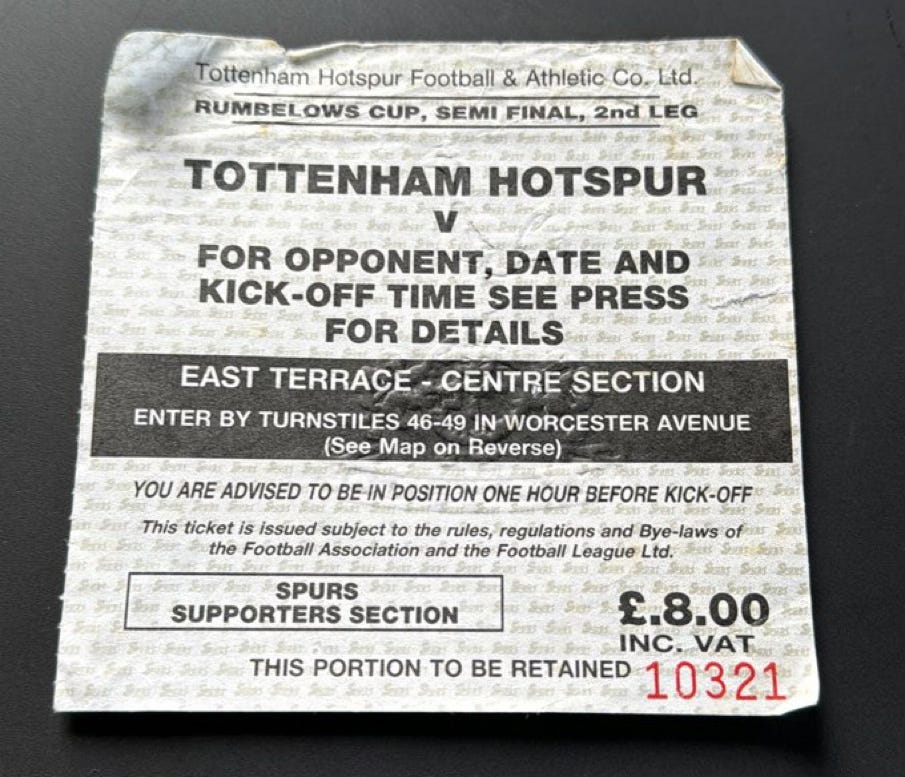
It’s worth pausing for a moment to remember that neither of those things caused what happened at Hillsborough. And also that proposals to outlaw the selling on of tickets and to introduce seating were considerably more enthusiastically adopted by football than some other major recommendations Taylor made – that fans should not be priced out and that a fair price for a ticket at the time (1994) would be £6.
But to return to the subject at hand, football clubs signed deals in which they gave so-called secondary agencies permission to resell tickets to their games in return for a payment. So the criminalisation of selling on tickets, alongside the rise of the ticketing agencies and their deals with clubs, has led to the absurd situation in which a fan can be arrested for selling a ticket at face value to another fan, while a secondary ticket agency that has signed a deal as an official club ticketing partner can resell a ticket for 10 times face value perfectly legally.
Most people saw what the secondary agencies were doing for what it was – legalised touting. One of the things that prompted me to get involved with the Supporters’ Trust at Spurs about a decade ago was the club’s deal with Stubhub. As a rule, fans don’t like touting because it has a negative impact on us and goes against many of the values built up over years of supporter culture, but the move sparked particular ire at Spurs because the club, with its then characteristic lack of awareness and penchant for shoving a foot up the barrel of the nearest shotgun, had just been running an “Out the tout” campaign.
The message seemed to be “Out the tout unless they have paid us a lot of money”. Research the Trust carried out showed that 91% of tickets being sold on Stubhub were being sold well above face value. So the Stop Stubhub coalition was born, a campaign that took us into meetings at the House of Commons with MPs such as Sharon Hodgson who have helped bring the current proposals forward, into conversation with ethical ticket exchanges such as Twickets, and finally to Spurs deciding to axe the deal – while saying they’d always intended to do that anyway.
A flavour of the debate, and the club’s attempts to defend the indefensible, can be found in this report from the local Tottenham Independent, which gave the campaign a lot of support.
The proposed new law may not apply to football, but there is an opportunity here. If the resale of tickets above face value is to be made illegal, that should logically mean it is illegal whether it is authorised or not. So the legislation should address this.
This week’s announcement does not, in itself, constitute a new law. It is an expression of intent to bring forward legislation in next year’s King’s Speech. What happens next is the process of haggling over wording and detail. Which is where some of the issues I’ve raised need to be tackled.
There’s also the issue of how UK law can be applied to a transaction that occurs overseas. The simple answer is that it can’t, and that’s why so many of the secondary ticketing agencies are registered outside the UK. But what if the law was written in such a way that it applied at the point of using the ticket at the event location?
Secondary ticketing is big business, which is why the industry put so much time and effort into trying to stop these proposals seeing daylight. Efforts to defenestrate the proposed legislation will continue apace, so fan organisations would do well to push for the detail that’s needed to make the new Bill work as it should.
As part of the process of making the improved fan engagement the new Independent Football Regulator will be looking for work, fan groups should be pushing clubs to recognise the direction of travel over the resale of tickets above face value. We need to finish the job of getting the secondary ticketing agencies out of football.
At the same time, we need to get rid of the poorly thought out legislation that criminalises fans for selling on tickets at face value. Such a transaction may well contravene club allocation schemes, in which case the instigator of the transaction would lose some or all of their privileges as a ticket holder under the rules of the scheme. There is no need for this transaction to be a criminal offence.
In a related move, the UK Competition and Markets Authority (CMA) announced a major drive targeting what it sees as unfair online pricing practices. Practices in the spotlight include drip pricing, where additional fees are added at various stages in the transaction process, and pressure selling, where techniques such as limited time offers are used to force customers into making quick purchase decisions without considering alternatives.
Eight companies have been targeted, and they include two of our secondary ticketing agency friends – Stubhub and Viagogo, the latter the target of action by supporters of Manchester City, one club which has a commercial deal with the agency.
Put these moves together with the #stopexploitingloyalty campaign that has been coordinated by the Football Supporters Association over the last 18 months and there’s evidence of a potential sea change in the way ticket sales are viewed. No one is arguing that businesses should not be able to charge prices that reflect demand, but what we’ve seen too often across music and football is the naked exploitation of the fan loyalty that helps fuel that demand. The passion and atmosphere dedicated fans provide is an integral part of a valuable product, not something to be squeezed until it is crushed.
To make sure that potential becomes something more substantial and lasting, fans are going to have to keep pushing their case.
Excellent article. Should be compulsory reading for all club administrators and for MP’s.
I am worried that those benefitting from the current lack of regulation, such as clubs and ticket agencies, will be lobbying strongly to make any legislation toothless.
An irony, of course, is the widespread use of sports event and concert tickets by those seeking to influence politicians.